Flat Roof Replacement across Leeds
Plenty of flat roofs around Leeds were laid decades ago in three layers of old-style felt over chipboard, with no insulation and very little fall. They did their job for a long time, but chipboard swells and crumbles once it has been wet, and that kind of felt goes brittle with age. When a roof like that has leaked more than once, has a spongy feel in several places, or holds water across most of its surface, a new roof is usually the sensible next step.
Replacement is not just a new top layer. The point is to fix what made the old roof fail. That might mean firmer boards, a better fall so the water runs off, an insulated build-up so the room below is warmer and free of condensation, or a different outlet position. We explain those choices in plain terms and put them in the written price as separate items, so you can see what each one adds.
The covering itself can be EPDM rubber, GRP fibreglass or modern reinforced felt. Each suits different roofs. The material chooser is a quick way to see which fits yours before we talk.
When replacement is usually the better choice
- The deck feels soft or bouncy in more than one place
- The roof has been patched several times and leaks keep appearing in new spots
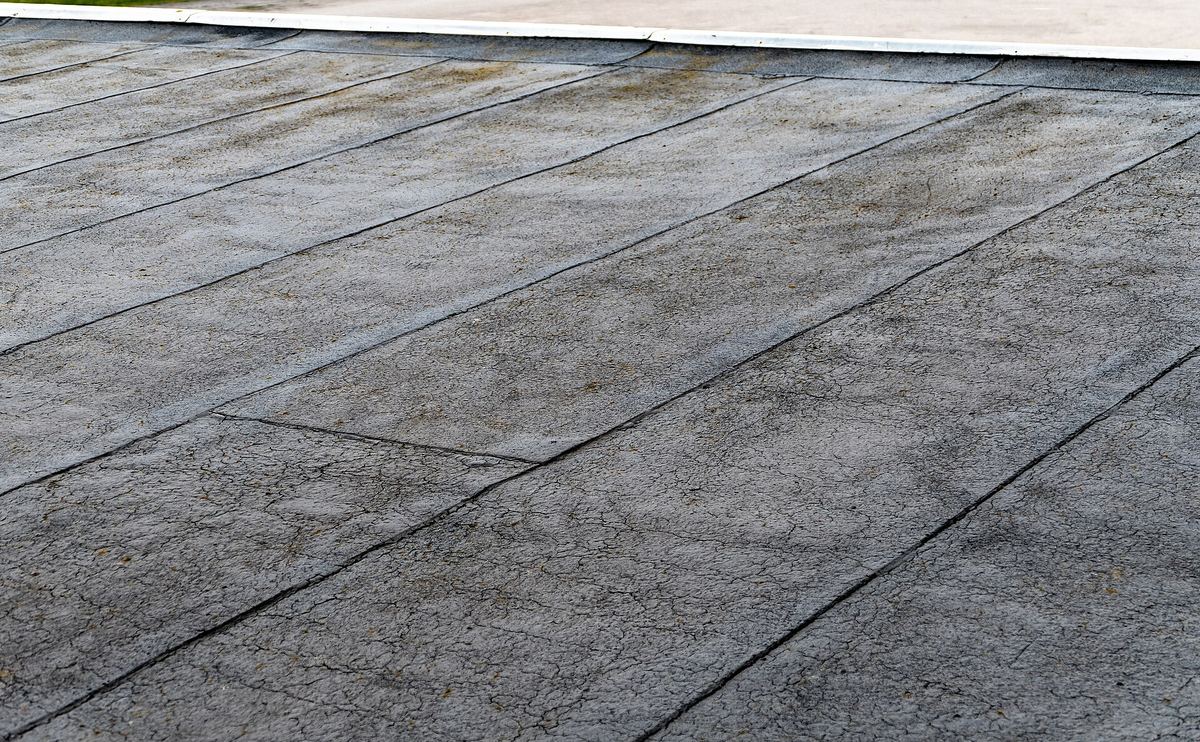
- Old felt is cracked and crazed across most of the surface, not just in one area
- Water sits over a large part of the roof because the deck has sagged
- The room below is cold and suffers from condensation or mould under the ceiling
- You are already changing the room below, for example adding a rooflight or replacing the ceiling
- Previous coatings or patches have built up so much that the original covering cannot be seen
What wears a flat roof out
Age of the covering
Traditional built-up felt was never meant to last as long as the house. Sunlight, frost and daily temperature changes slowly harden the bitumen until it cracks.
The deck under it
Chipboard decking loses its strength when it gets wet and does not recover. Once one area softens, water spreads through the boards and the problem grows.
No fall, or a lost fall
Flat roofs should fall towards an edge or outlet. Many older ones were laid almost level, or the joists have deflected over time, so water ponds instead of draining.
No insulation
An uninsulated flat roof is cold underneath. In winter, moisture from the house condenses under the deck, soaks the boards from below and rots them from the inside.
What a replacement involves
1. Survey and decide
We check the joists, the deck and the edges, and how the roof meets the house. You get a written price with the options set out, including whether insulation is needed and how the falls will be formed.
2. Protect and strip
The area below is protected, the old covering is stripped and taken away, and the deck is checked board by board. Anything soft or rotten comes out.
3. Build the structure up
New boards are fitted, usually OSB3 or exterior plywood. Falls are formed with tapered firrings or tapered insulation. On a warm-roof build-up, a vapour control layer and rigid insulation go on top of the deck before a final board.
4. Lay the covering
The chosen membrane is laid to the manufacturer's method, turned up walls and kerbs, and finished into proper edge trims and outlets.
5. Flash and finish
Lead or a suitable flashing is set into the wall above the upstand. Gutters and outlets are checked, debris is cleared, and you are shown the finished roof.
EPDM, GRP and reinforced felt for a replacement roof
| EPDM rubber | GRP fibreglass | Reinforced felt | |
|---|---|---|---|
| What it is | A single sheet of synthetic rubber, bonded to the deck | Glass-fibre matting set in resin and finished with a coloured topcoat | Two or three layers of polyester-reinforced bitumen with a mineral cap sheet |
| Joints | Usually none on a small roof; one sheet covers it | None: it is laminated as one continuous skin | Overlapping laps between sheets, bonded together |
| Laying | Cold-applied adhesives, no flame | Cold-applied, but needs dry weather and moderate temperatures for the resin to cure | Torched on, or self-adhesive and cold-applied where a flame is not suitable |
| Best suited to | Simple shapes, garages, extensions, roofs where a quiet look matters | Roofs with detail, balconies and walkable areas, crisp edges | Larger or more complex roofs, commercial units, roofs mixed with older felt |
| Look | Matt black | Smooth, colour of your choice, usually grey | Mineral finish, usually grey, green or black |
| Repairs later | Patched with cured EPDM and seam tape | Ground back and re-laminated | Patched with matching reinforced felt |
Not sure which suits your roof? The material chooser asks five questions and shows how each one fits.
Worth knowing
Building Regulations
Re-covering a large share of a roof, or replacing the deck and insulation, can bring the work under Building Regulations, including the insulation standards. We tell you where that is likely to apply so it can be checked with Leeds Building Control before work starts.
Warm roof or cold roof
Most new flat roofs over heated rooms are built as warm roofs, with insulation above the deck. That keeps the timbers on the warm side and avoids the condensation problems of older cold, ventilated roofs. It raises the roof level slightly, which affects edge and wall details.
Asbestos on older garages
Some old garage and outbuilding roofs are corrugated cement sheet that may contain asbestos. That has to be identified and dealt with under HSE rules before anyone breaks it up, and we will explain that before any price is given.
Neighbours and access
On terraces and semis, extension roofs often butt up to a neighbour's wall or roof. Where work affects a party wall or needs access from next door, we flag it at the pricing stage.
Related flat roof work
EPDM Rubber Roofing
One-piece synthetic rubber membranes bonded to a new deck, with proper trims and upstands. Few joints, so few places to fail.
More on this →GRP Fibreglass Roofing
Glass-fibre matting laid in resin and finished with a topcoat, moulded round corners and edges into one seamless skin.
More on this →Felt & Torch-On Roofing
Modern reinforced bitumen in layers: a base sheet and a mineral cap sheet, torched or self-adhered depending on the building.
More on this →Extension Flat Roofs
Kitchen and back extensions where the roof meets the house wall, with rooflights, outlets and the falls that move the water off.
More on this →Where we do this
Everywhere in the Leeds district. Pages for places where this work comes up a lot: Seacroft, Middleton, Garforth, Pudsey, Moortown, Wetherby. For anywhere else, type your town or postcode into the area finder.
Flat Roof Replacement: questions people ask
- The deck is the main clue. If the boards are soft in more than one area, or the covering is brittle and cracked across the whole roof, repairs will keep chasing new failures. If the deck is firm and the fault is local, a repair is usually the better value. We show you what we find so you can judge it too.
- Sometimes a new covering can go over a sound old one, but only when the deck is dry and firm, the old surface is suitable and the extra height works at the edges and walls. In most of the older roofs we see, the deck is the problem, so the old roof comes off.
- If the condensation comes from a cold, uninsulated roof, an insulated warm-roof build-up is the usual cure, because it keeps the underside of the deck warm. Ventilation in the room still matters. We look at the cause before saying the roof alone will solve it.
- Like-for-like replacement of a flat roof on an ordinary house does not normally need planning permission. Raising the roof noticeably, adding a roof terrace or working on a listed building or in a conservation area can be different. Building Regulations can apply to re-covering, and we flag that when we price.
- A single garage or small extension roof is often a short job, provided the weather stays dry. Bigger roofs, rotten decks and roofs that need new falls take longer. We give you a realistic plan with the written price and explain how the roof is kept watertight overnight while work is under way.