Flat roofs only, all over Leeds EPDM, GRP and reinforced felt We look before we price Price agreed in writing first Garages, extensions and dormers Landlords and agents welcome Flat roofs only, all over Leeds EPDM, GRP and reinforced felt We look before we price Price agreed in writing first Garages, extensions and dormers Landlords and agents welcome
Flat roof specialists · every Leeds postcode
Flat roofing in Leeds
Garage roofs, kitchen extensions, dormers and bays: repaired where a repair will last, renewed where it will not. Rubber, fibreglass or reinforced felt, laid on a deck that has been checked first.
That is normal: most people only see their flat roof from a bedroom window. Old felt is usually grey or green and gritty, rubber is smooth matt black, and fibreglass is hard and glossy.
JoistsDeck boardsVapour control layerInsulationMembrane and upstandEdge trim
Flat roof services
Flat roofs are all we do.
Repairs, leaks and full replacement; the three main coverings; and the roofs people ask us about most. Every page sets out the signs, the causes, how the work is done and the questions worth asking.
It is nearly always the deck, the fall or an edge.
1
Boards that have been wet
Many older Leeds flat roofs sit on chipboard. Once it has soaked up water it swells, softens and stops holding fixings, and no new covering will stay sound on top of it.
2
Water with nowhere to go
A flat roof should still fall towards a gutter or outlet. Where it has sagged or was laid level, puddles sit on it for days and wear the covering out from the top.
3
The edges and the wall line
Upstands, flashings, trims and rooflight kerbs move more than the middle of the roof. That is where most leaks begin, and where we look first.
4
Cold underneath
An uninsulated flat roof over a warm kitchen can drip with condensation in winter. A warm-roof build-up keeps the timbers dry from below as well as above.
Rubber, fibreglass or felt
Three good systems. One will suit your roof best.
We lay all three, so there is no reason to push one. The right choice depends on the shape of the roof, how much detail it has, whether people walk on it, how it is reached and what it joins on to.
EPDM rubber
GRP fibreglass
Reinforced felt
Joins across the roof
None on most garages
None, it is one laminate
Overlapping, bonded laps
Laid with a flame?
No
No
Torch-on yes; cold-applied no
Suits best
Plain garages and extensions
Dormers, balconies, detailed roofs
Large, complex or mixed roofs
Finished look
Matt black
Smooth, in a chosen colour
Mineral grit, grey or green
Still not sure? The material chooser asks five questions about your roof and shows how each system fits.
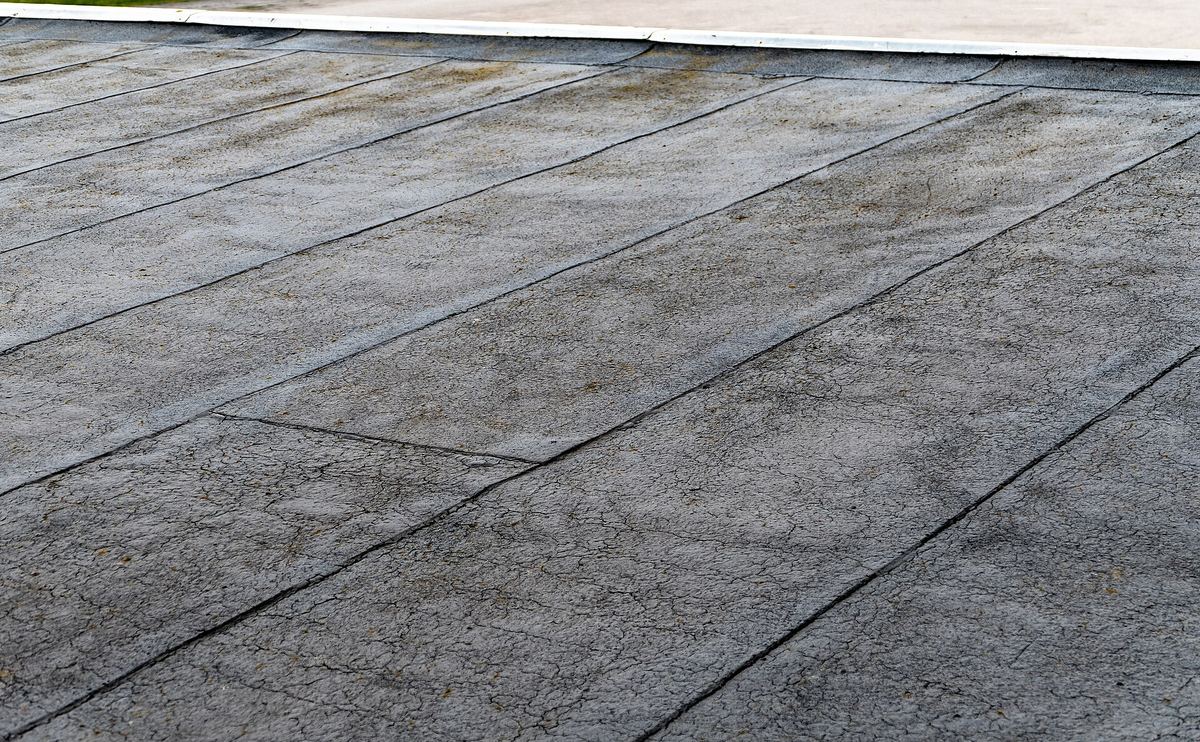
Old felt with every lap showing and the surface worn grey: the kind of roof that has usually reached the end of its life. Library photo of a weathered felt flat roof, taken in Sweden; not a roof we worked on. Photo: W.carter, CC0 1.0 (Wikimedia Commons).
How it works
From the first call to a dry roof.
1
Tell us about it
What the roof is over, what you have noticed and roughly where. A photo from a window or the garden helps.
2
We look at the roof
The surface, the edges, the deck underfoot and, where we can, the underside. You are told what has failed and why.
3
Price on paper
Repair or replacement, materials, access and any timber work, each written down. Nothing starts until you agree.
4
Work done, water checked
The roof is finished, the gutters and outlets cleared, and you are shown the result before we leave.
Where we work
The whole Leeds district.
Garages behind the semis of Cross Gates and Moortown, kitchen extensions on the terraces of Headingley and Armley, dormers in Harehills and Burley, bungalows in Garforth and Cookridge, shops and flats in the city centre, and the stone villages out to Otley and Wetherby. Each of the 104 areas has its own page.
It depends far more on how it was built than on the material. A covering laid on a firm, dry deck with a proper fall, good edges and clear outlets lasts much longer than the same material on soft boards with puddles sitting on it. Old-style felt over chipboard is the type most often at the end of its life now.
If the deck is firm and the fault is in one place, such as a split, a lifted edge or a failed upstand, a repair usually makes sense. If the boards are soft in several places or the covering is cracked all over, replacement is better value. We show you what we find before recommending either.
Each suits different roofs. Rubber is quick and seamless on simple shapes, fibreglass handles detail and foot traffic, and reinforced felt copes with large or mixed roofs. Our material chooser walks through the questions that decide it.
Yes. Plenty of water that lands on a flat roof comes from the slates, gutters or lead above it. We are roofers, so the junction between the flat roof and the main roof is part of the look.
Phone the office, send the contact form, or send a photo first. We then look at the roof and put the price in writing, with the access, the materials and any extra work listed separately, before anything is agreed.
Flat roof giving you trouble?
Tell us what it is doing. We look first and put the price in writing before any work starts.