Flat Roof Repairs across Leeds
Most flat roofs in Leeds sit over something people care about: a kitchen extension, a garage full of stored things, a bay window or a bedroom dormer. When one starts to let water through, the first question is whether it needs mending or replacing. More often than people expect, the honest answer is mending. A split along a lap, a blister that has burst, a trim that has pulled away or an upstand that has shrunk back from the wall are all local faults, and a sound roof with one of them can carry on for a good while once it is put right.
The catch is that a repair only works on a roof that is otherwise healthy. Before anything is priced we walk the surface where it is safe to do so, press the deck to feel for soft areas, look at the edges and outlets, and check from inside where we can. If the boards are spongy over a wide area, or the covering is crazed and brittle all over, a patch will not hold for long and we will say so plainly, with the evidence.
Repairs are made in the same family of material as the roof: reinforced bitumen on a felt roof, EPDM with the correct primer and seam tape on a rubber roof, and resin with matting on a fibreglass one. Mixing systems, or smearing a tub of black compound over a crack, tends to buy weeks rather than years.
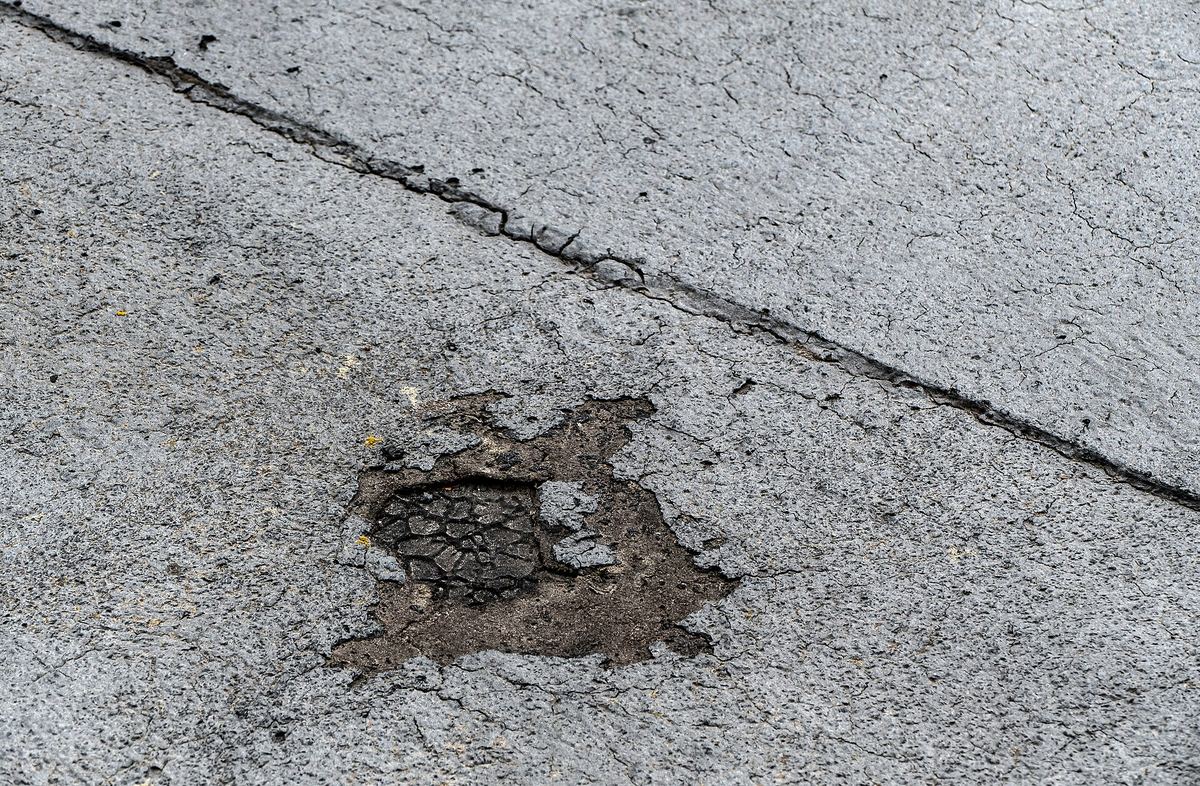
Signs a flat roof needs a repair
- A drip or stain that appears after heavy rain and dries out in between
- A bubble or blister in the felt that has split open or feels hollow underfoot
- Cracks in the surface of an old felt roof where the mineral chippings have worn away
- A seam or lap edge that has lifted, so you can slide a finger underneath
- The covering pulling down from the wall at the back of the roof, leaving a gap at the top of the upstand
- A drip trim at the edge that has come loose or split, with staining down the fascia below
- A puddle that sits for days after rain in the same low spot
- Moss, grass or silt building up around the outlet or along one edge
Why flat roofs fail in patches
Movement at the edges
A flat roof expands and contracts every day. Where the covering meets a wall, a fascia or a rooflight kerb, that movement is concentrated, and older felt or poorly bonded rubber eventually cracks or peels at those lines first.
Water that cannot get away
A roof laid with too little fall, or one whose deck has sagged between joists, holds puddles. Standing water speeds up wear on felt, and once a puddle sits over a seam it finds any small gap in it.
Trapped moisture
Blisters form when water or vapour trapped under a felt layer expands in sunshine. A small blister may sit harmlessly for years; one that cracks open lets rain straight into the layer below.
Foot traffic and impacts
Ladders resting on the edge, window cleaners stepping off, satellite dishes bolted through, or a branch landing in a storm can all puncture a membrane in one place.
Earlier patch-ups
Mastic, paint-on coatings and offcuts stuck down without primer often trap water underneath and hide what is happening. Part of a good repair is cutting those back to sound material.
How a flat roof repair is carried out
1. Look first
We find the failed point, then check the deck around it by feel and, where it is accessible, from below. The repair is only offered if the surrounding roof is sound enough to take it.
2. Price in writing
You get the repair, the materials and any access set out in writing. If a ladder will not do safely, a tower or edge protection is shown as its own line.
3. Cut back and prepare
Lifted or blistered material is cut out to a clean edge. Surfaces are cleaned and dried and, on rubber and felt, primed so the new material bonds rather than sits on top.
4. Make the repair
On felt, a reinforced patch is bonded and its edges sealed. On EPDM, a cured rubber patch goes down with primer and seam tape. On GRP, the area is ground back and re-laminated with matting and resin, then topcoated.
5. Check the water route
Outlets, gutters and trims are cleared and checked, because a repair next to a blocked outlet is soon under water again.
Worth knowing
A repair is not a refurbishment
Liquid coatings sold as a cure-all can have a place on a sound roof, but they cannot fix a rotten deck or a roof with no fall. We do not coat over a fault to make it look new.
Wet boards change the job
If the deck under the leak has softened, those boards are cut out and replaced as part of the repair. That is explained and agreed before it is done, not added afterwards.
Weather matters
Bitumen and adhesives need a dry surface, and fibreglass resin needs a dry day that is not too cold to cure. In a long wet spell, a temporary weatherproof cover may come first and the proper repair when conditions allow.
Pitched roof nearby?
Many leaks blamed on a flat roof come from the slates, tiles or lead above it. We are roofers, so we check the pitched roof where it meets the flat one rather than stopping at the boundary.
Related flat roof work
Flat Roof Leaks
Water on a flat roof travels along the deck before it drips, so we trace it to the real entry point: an outlet, a joint, a wall or a seam.
More on this →Flat Roof Replacement
When the boards are soft or the covering has failed all over: stripped to the joists if needed, re-decked, insulated and re-covered.
More on this →Lead Flashing on Flat Roofs
The cover between a flat roof and a wall or chimney: cut into the joint, dressed down over the upstand and fixed, not glued.
More on this →Flat Roof Edges, Gutters & Fascias
Drip trims, gutters, outlets and the fascia boards along a flat roof edge, where most of the water leaves the roof.
More on this →Where we do this
Everywhere in the Leeds district. Pages for places where this work comes up a lot: Headingley, Roundhay, Horsforth, Moortown, Morley, Cross Gates. For anywhere else, type your town or postcode into the area finder.
Flat Roof Repairs: questions people ask
- Yes, as long as the rest of the deck and covering are in reasonable condition. A local split, blister or failed edge can be cut out and repaired in matching material. If the roof is brittle or soft across most of its area, a patch will be overtaken by the next failure, and we will show you why before suggesting anything bigger.
- Usually. Rubber is repaired with a cured EPDM patch, the correct primer and seam tape, after the area has been cleaned. The common faults are lifted perimeter edges, failed seams on roofs laid in strips and punctures. Glued-on felt or mastic does not bond to rubber properly, so earlier repairs of that kind are removed first.
- GRP repairs are ground back, re-laminated and topcoated, so they are watertight and strong. The new topcoat is unlikely to match the colour of a faded roof exactly, so a repair will usually be visible from above, even though it does its job.
- A thin film of water that clears within a day or two is common. A deep puddle that sits for days in the same place usually means the deck has sagged or the fall is wrong, and over time it shortens the life of the covering. A repair can deal with a leak, but curing the puddle normally means re-forming the fall.
- Where we can, yes. A loft hatch over an extension, a garage with an open ceiling or a stain on a plasterboard ceiling all help to show where water is travelling. It is not always possible, and the roof is checked from outside either way.